Posts

Einstein's Theory of General Relativity
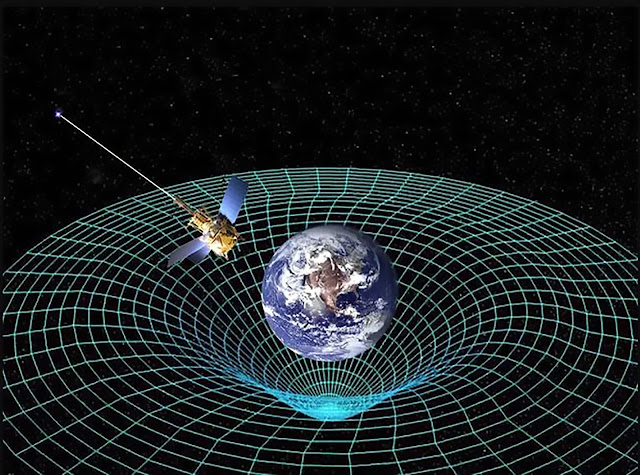
Image
In 1905, Albert Einstein determined that the laws of physics are the same for all non-accelerating observers, and that the speed of light in a vacuum was independent of the motion of all observers. This was the theory of special relativity. It introduced a new framework for all of physics and proposed new concepts of space and time. Einstein then spent 10 years trying to include acceleration in the theory and published his theory of general relativity in 1915. In it, he determined that massive objects cause a distortion in space-time, which is felt as gravity. The tug of gravity Two objects exert a force of attraction on one another known as "gravity." Sir Isaac Newton quantified the gravity between two objects when he formulated his three laws of motion. The force tugging between two bodies depends on how massive each one is and how far apart the two lie. Even as the center of the Earth is pulling you toward it (keeping you firmly lodged on the ground), you...

Moisture unmasks camouflaged message

Image
This is one in a series presenting news on technology and innovation, made possible with generous support from the Lemelson Foundation. Nature’s colors can delight the eye. But these dazzling displays can also have many practical uses. For example, some animals hide themselves from predators by changing color to blend into their surroundings. This is known as camouflage. Researchers from Europe have taken inspiration from this to develop a new material. It changes color when exposed to moisture. And the researchers can decide beforehand which colors or patterns that moisture will reveal. It all has to do with the new material’s structure. Consider a peacock’s feathers. They’re a fairly boring brown. Yet your eye doesn’t perceive them that way. The features appear vibrant and multi-colored due to what’s known as structural color. Microscopic features on a plume’s surface can reflect or scatter light in some special way. This alters the material’s apparent color. Waves ...

Some TRAPPIST-1 planets may be water worlds

Image
WATER WORLDS  The TRAPPIST-1 system, with seven Earth-sized planets orbiting a dwarf star, has captured the attention of scientists hunting for life outside the solar system. New estimates of the planets’ composition indicates that several are enveloped in water and ice. There’s so much water on some of TRAPPIST-1’s seven Earth-sized planets that any life lurking there might be difficult to detect. New estimates of the makeup of these potentially habitable worlds suggests that two of them are more than half water, by mass, researchers report March 19 in Nature Astronomy. Earth, by comparison, is less than 0.1 percent water. TRAPPIST-1’s planets are so wet that most of the water probably isn’t even liquid, but ice formed under high pressure, says Cayman Unterborn, an exogeologist at Arizona State University in Tempe. That would change the chemistry happening on the planet in a way that could make any signs of life tricky to distinguish from geochemical processes. TRAPPIST...

Astronomers can’t figure out why some black holes got so big so fast

Image
TOO BIG, TOO SOON  Supermassive black holes that are actively feeding on gas and dust, like the one shown in this artist’s rendition, have been spotted in the early universe — before they should have had time to grow. The existence of supermassive black holes in the early universe has never made much sense to astronomers. Sightings since 2006 have shown that gargantuan monsters with masses of at least a billion suns were already in place when the universe was less than a billion years old – far too early for them to have formed by conventional means. One or two of these old massive objects could be dismissed as freaks, says theoretical astrophysicist Priyamvada Natarajan of Yale University. But to date, astronomers have spotted more than 100 supermassive black holes that existed before the universe was 950 million years old. “They’re too numerous to be freaks now,” she says. “You have to have a natural explanation for how these things came to be.” The usual hypotheses are ...

Common mosquito can carry Zika virus: Brazilian scientists

Image
The common Culex mosquito is able to transmit the harmful Zika virus, Brazilian scientists have discovered. Scientists at the Oswaldo Cruz Foundation (Fiocruz) in the Pernambuco state revealed that the virus can reach the insect’s salivary gland, “which is believed to indicate that Culex mosquitoes may be one of the vectors of the Zika virus”, reports Xinhua news agency. Until now it was believed that the virus was spread by the Aedes Aegypti, a less common variety of mosquito that also carries the diseases dengue and chikungunya. The team’s findings were published on Wednesday by the Nature group. Fiocruz said it will now analyse the physiological and behavioural characteristics of the Culex in its natural environment “to understand the role and the importance of this species in the transmission of the Zika virus”. While the virus is not fatal to humans, it has been linked to serious birth defects in infants born to women who were exposed to the mosquito-borne disease, ma...

Who owns Mars?

Image
Can anyone claim the red planet or natural resources on asteroids? Business leaders and legal experts say the question has become more than philosophical as a growing number of firms, often backed by capital and technology from Silicon Valley, have set their sights on the resources of outer space asteroids and Mars. In order to avoid conflicts between competing companies and countries over outer space resources, more work needs to be done on Earth to determine who owns commodities taken from celestial bodies, analysts said. “There is a huge debate on whether companies can simply travel to space and extract its resources,” said Barry Kellman, a law professor who studies space governance at DePaul University in Chicago. “There is no way to answer the question until someone does it,” Kellman told the Thomson Reuters Foundation. ASTEROID WATER FOR SALE U.S.-based Planetary Resources, a firm backed by Google founder Larry Page and Virgin Group’s Richard Branson, expects to ...

Japan scientists grow drugs in chicken eggs

Image
Japan scientists grow drugs in chicken eggs Japanese researchers have genetically engineered hens whose eggs contain drugs that can fight serious diseases including cancer, in a bid to dramatically reduce the cost of treatment, a report said Monday. If the scientists are able to safely produce "interferon beta", a type of protein used to treat illnesses including multiple sclerosis and hepatitis, by rearing the hens, the price of the drug -- currently up to 100,000 yen ($888) for a few microgrammes -- could fall significantly, said the English edition of the Yomiuri Shimbun. Researchers at the National Institute of Advanced Industrial Science and Technology (AIST) in the Kansai region kicked off the process by introducing genes that produce interferon beta into cells which are precursors of chicken sperm, the newspaper reported. They then used these cells to fertilise eggs and create hens which inherited those genes, meaning the birds were able to lay eggs containi...